
 +86-18750595100



Copyright © 2025 Fujian Xinyun Machinery Development Co.,Ltd. All rights reserved. Site Map


Time: 2026-09-09
The packing machine is the final and often bottleneck stage of a toilet paper line, and the choice between single roll and multi roll packing decides throughput, floor space, and labor. This article compares single roll and multi roll toilet paper packing machines on speed, layout, changeover, and scale. Xinyun Machinery has supplied both packing types to buyers in Africa, South America, and the Middle East, and details the technical comparison below.
A single roll packing machine wraps one toilet paper roll per pack with a heat-seal film or label wrap. A multi roll packing machine bundles several rolls, typically 4, 6, 8, 10, or 12, into one bag or shrink pack. The two machines serve different retail formats and connect differently to the upstream rewinder and cutter.
Single roll packing targets promotional or premium single rolls sold in supermarkets and hotels. The machine feeds one roll, wraps it, and ejects a sealed pack at a steady cadence. This format needs more film per roll but suits markets that sell loose or gift rolls.
Multi roll packing targets value packs of 4 to 12 rolls for household and institutional buyers. The machine collates rolls from the line, pushes them into a bag, and seals the bundle. This format cuts film cost per roll and matches bulk-buy demand in African and South American retail.
Xinyun single roll packing machines typically run at approximately 60 to 100 packs per minute depending on roll diameter, and actual speed varies by model. Xinyun multi roll packing machines typically run at approximately 20 to 40 bundles per minute, with each bundle equal to several rolls. In roll equivalents, a multi roll line often outpaces a single roll line because each cycle packs many rolls at once.
An entry toilet line produces 1 to 2 tons of finished product per day, which a single or small multi roll packer handles without backup. Wider automatic lines at up to 5 tons per day need a multi roll packer to avoid a packing bottleneck. The XY-TQ-B toilet paper machine at up to approximately 180 to 230 meters per minute feeds more rolls than one single roll packer can wrap.
Single roll packing has a short cycle but packs one roll each time. Multi roll packing has a longer cycle but packs a full bundle each time. Calculate rolls per minute, not packs per minute, when comparing the two machines for your line.
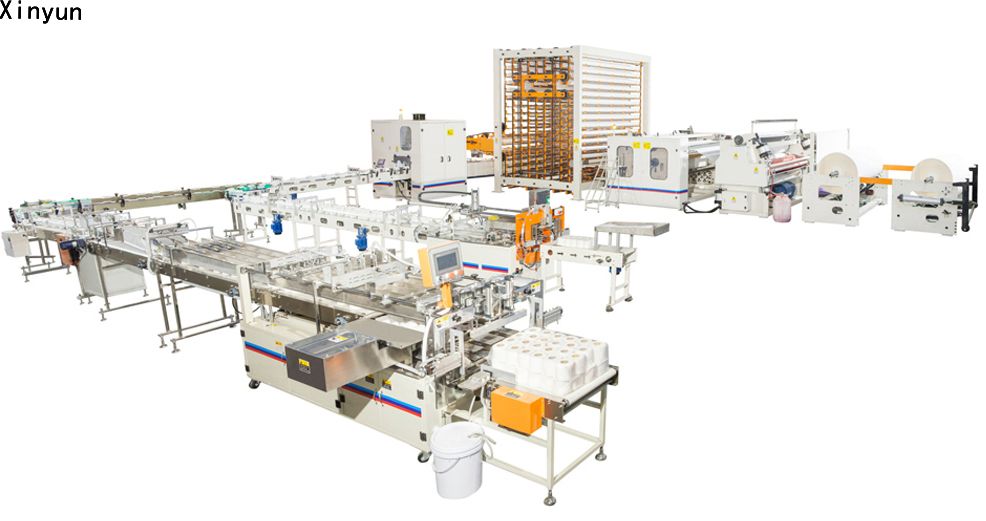
A single roll packing machine occupies a compact footprint, often under 10 square meters, and fits a startup line with an upstream parent roll width of 1200 to 2800 mm. A multi roll packing machine needs more space for the collation conveyor and film roll storage, typically 15 to 25 square meters. Plan the packing zone separately from the rewinder to keep material flow straight.
An upstream toilet line with parent roll width of 1200 to 2800 mm fits a workshop above 100 square meters including packing. Widths above 2000mm require more than 300 square meters across rewinding, cutting, and packing. Multi roll packing adds conveyor length that many first-time buyers underestimate during layout.
Single roll packing uses narrow film reels and a simple heat sealer with low power draw. Multi roll packing uses wider film and a stronger sealer or shrink tunnel with higher power. Confirm film width supply locally before specifying the packer.
Single roll packing changes format by adjusting roll diameter and film length on the control panel. Multi roll packing changes format by adjusting the collation count and lane guides for 4, 6, 8, 10, or 12 rolls. Both changes take minutes on Xinyun machines, but the parts differ.
Switching roll diameter on a single roll packer needs a guard and film setting change only. The machine stays on one roll per pack, so SKU variety is limited to diameter and wrap. This simplicity suits plants with a fixed single-roll product.
Switching from 6 to 12 rolls needs lane guide adjustment and collation timing change. The same machine serves several pack sizes, which helps plants serving both retail and institutional buyers. Keep spare lane guides on site to shorten changeover during peak orders.
A single roll packer needs 1 operator to feed and monitor, with more hands if rolls arrive loose. A multi roll packer needs 1 operator who watches the collation and seals, with rolls fed automatically from the line. Film cost per roll is lower on multi roll packing because one bag covers many rolls.
Single roll packing uses one wrap per roll, raising film consumption at high volume. Multi roll packing shares one bag across 4 to 12 rolls, cutting film cost significantly. Over a month of bulk production, the film saving often offsets the higher machine price.
Single roll packing has fewer moving collation parts, so mechanical faults are rare. Multi roll packing adds collation and push mechanisms that need cleaning and adjustment. Train operators on both formats through Xinyun's installation support to keep downtime low.
Match the packer to daily output, retail format, and warehouse SKU plan rather than to price alone. Single roll packing fits promotional and premium lines; multi roll packing fits bulk household and institutional volume. Both connect to lines producing 1 to 2 tons per day at startup.
A single roll packer suits a startup line with an upstream parent roll width of 1200 to 2800 mm serving local hotels and small retail. The compact footprint and simple operation keep early labor and space cost low. It is the safer first packer when volume stays under 2 tons per day.
A multi roll packer suits lines approaching 5 tons per day and national retail contracts. The bundle format matches bulk-buy demand and lowers film cost per roll. Pair it with a wider automatic rewinder above 2000mm for full-line balance.
Plants serving both channels can install one single roll packer for premium SKUs and one multi roll packer for bulk SKUs. This dual setup covers more contracts without overloading either machine. Xinyun can size both packers to the same upstream parent roll width for shared spare parts.
Single roll and multi roll toilet paper packing machines differ in format, speed measured in rolls per minute, floor space, and film cost. Single roll packing typically wraps one roll at approximately 60 to 100 packs per minute on a compact footprint; multi roll packing typically bundles 4 to 12 rolls at approximately 20 to 40 bundles per minute with lower film cost per roll. Both fit lines from 1 to 2 tons per day up to 5 tons per day, served by an upstream paper line with parent roll width of 1200 to 2800 mm.
Xinyun offers the Toilet Paper Machine category with XY-TQ-B automatic lines, and the Tissue Paper Machine category for broader tissue configurations. The XY-TQ-B Toilet Paper Machine product page details a line running at up to approximately 180 to 230 meters per minute.
Contact Xinyun Machinery for a customized quote and production line proposal tailored to your market. Tell us your daily output, pack format, and workshop size, and we will recommend the right single or multi roll packer with installation support. Get your machine price today.

Professional Manufacturer of Tissue Paper Making Machine.





By continuing to use the site you agree to our privacy policy.