
 +86-18750595100



Copyright © 2025 Fujian Xinyun Machinery Development Co.,Ltd. All rights reserved. Site Map


Time: 2026-07-14
Toilet paper production problems can reduce efficiency by 15% to 40% if not identified and corrected quickly. Based on field data from installations across Africa, South America, and the Middle East, this guide covers the most frequent issues in toilet paper rewinding and converting lines — and how to fix them.
Paper tearing during rewinding reduces production speed by 20% to 30%. The most common cause is incorrect tension control between the parent roll unwinding unit and the rewinding drums. When tension exceeds 3.5 kg/cm² for standard tissue paper (13 to 18 gsm), the web tears.
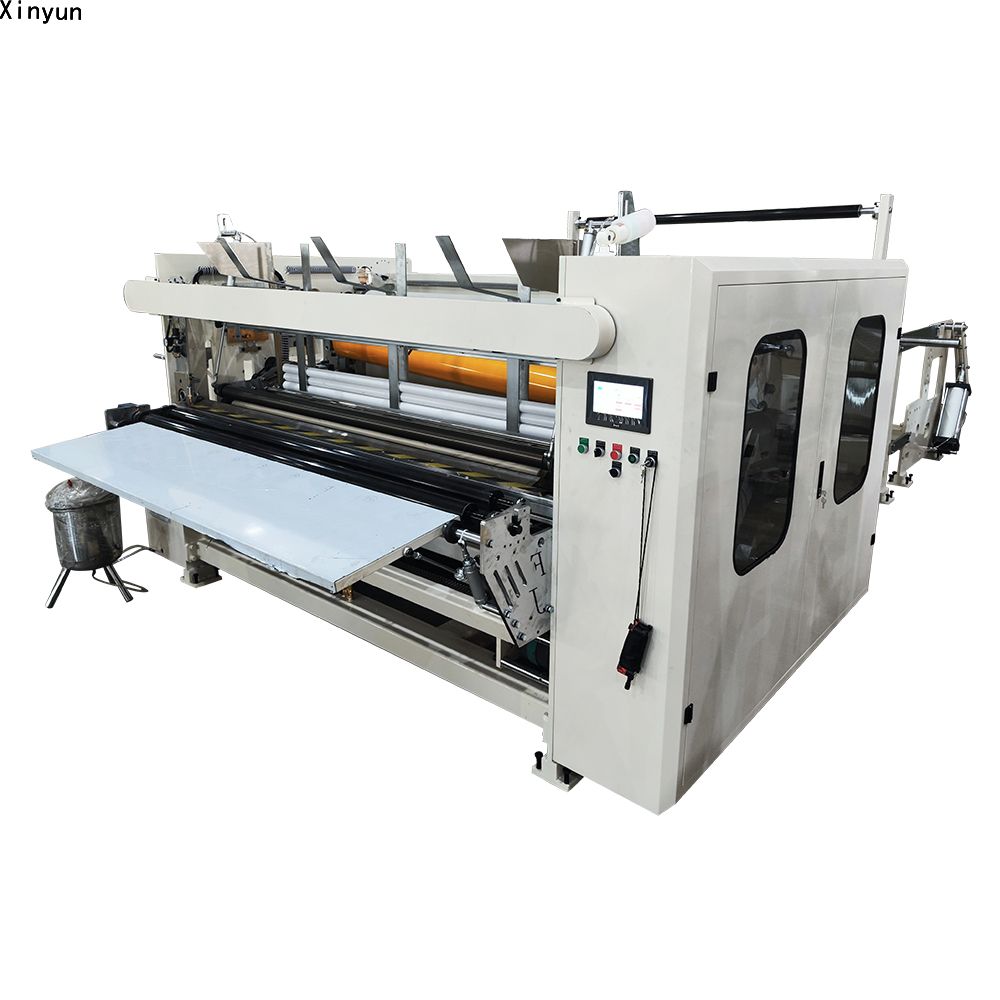
Adjust the pneumatic brake on the parent roll backstand. Reduce tension gradually until the paper runs smoothly. The ideal tension setting for most tissue grades is between 2.0 and 3.0 kg/cm². If the machine uses mechanical friction brakes, replace worn pads every 6 months. Xinyun's XY-TQ-B series machines use pneumatic loading systems with independent roll adjustment, allowing precise tension control for each parent roll.
Use a tension controller with real-time display. Train operators to check tension settings at the start of each shift. Install a paper accumulator device — available as an option on XY-TQ-B models — which buffers tension fluctuations during roll splicing.
Uneven perforation lines cause customer complaints and packaging waste. The most common cause is a worn perforation blade after 200 to 300 hours of operation. Misaligned anvil blades or incorrect pressure settings also contribute.
Replace perforation blades every 3 months or after 300 hours of continuous operation. Standard toilet paper requires 4 anvil blades for perforation distances of 90mm to 150mm, or 2 anvil blades for 180mm to 300mm spacing. Xinyun Machinery's machines use 4 high-precision spiral knives with gearbox drive, which deliver consistent perforation and lower noise compared to straight blade systems.
Inspect blade sharpness weekly. Keep spare blades in stock — a spare set costs approximately USD 50 to USD 150 depending on blade type. Use the machine's PLC diagnostic system to detect perforation pressure variations early.
Telescoping — where paper layers shift horizontally in the finished log — occurs when the rewinding drum speed does not match the paper feed speed. This issue is common during startup and paper grade changes. High moisture content in the parent roll (above 8%) also contributes.
Check that the parent roll moisture content is between 4% and 7%. Reduce rewinding speed by 10% to 15% during the first 50 meters of a new roll. On Xinyun machines with PLC touchscreen control, operators can adjust speed ramping parameters directly from the control panel.
Store parent rolls in a dry warehouse with humidity below 70%. Allow imported paper rolls to acclimate for 24 to 48 hours after arrival before processing.
Excessive dust during slitting and rewinding indicates dull slitting blades or incorrect slitting pressure. Dust accumulation affects product quality and can cause respiratory issues for operators. It also increases fire risk in dry production environments.
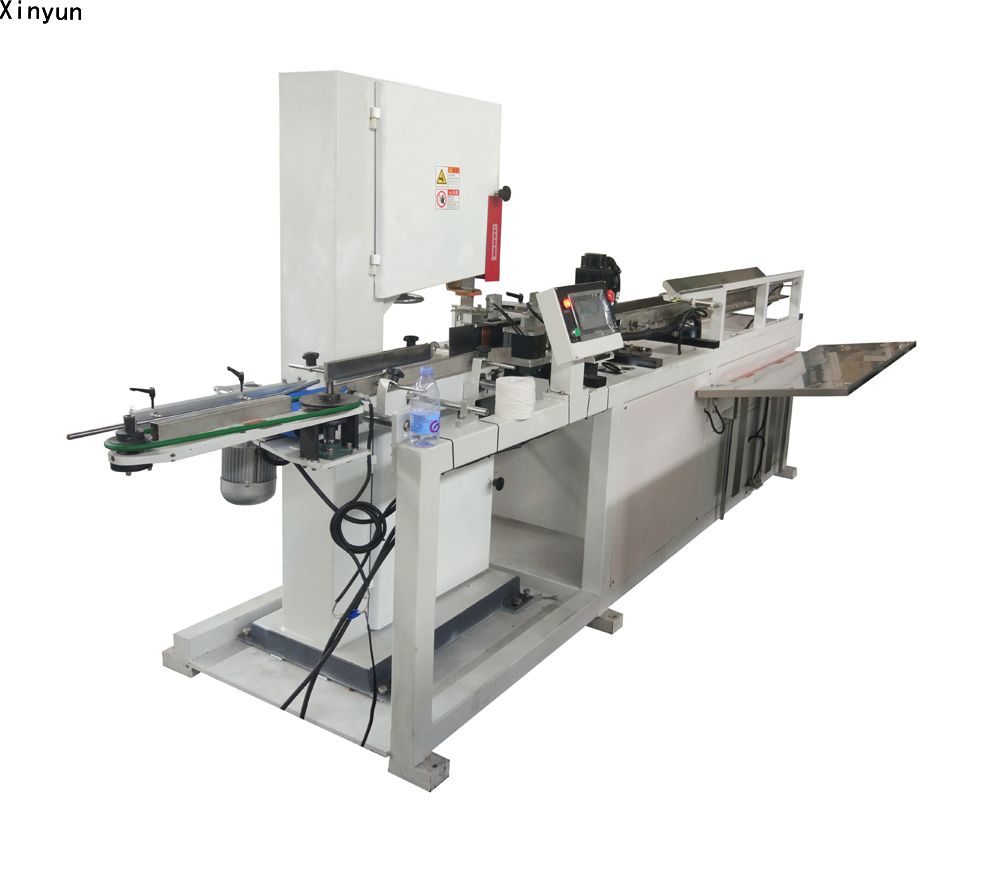
Sharpen or replace slitting blades every 200 to 300 hours. Maintain a blade overlap of 0.5 to 1.0mm between the upper and lower slitting knives. Install a dust extraction system near the slitting station. Xinyun's band saw cutting machines (XY-AI series) include integrated knife-sharpening units that automatically maintain blade sharpness during operation.
Implement a weekly cleaning schedule for the slitting area. Use compressed air to remove paper dust from electrical cabinets and PLC units. Install industrial-grade air filters if the workshop has poor ventilation.
Weak tail glue seals cause logs to unravel during handling and packaging. Common causes include incorrect glue viscosity, clogged glue nozzles, or insufficient glue drying time. Ambient workshop temperature below 15°C also affects glue performance.
Use PVA-based tail glue with a viscosity of 5000 to 8000 mPa·s for standard toilet paper. Clean glue nozzles daily with hot water. On Xinyun's automatic production lines, the glue spraying and sealing system operates synchronously with edge trimming, applying glue precisely at the tail position. The glue drying time is automatically adjusted based on line speed.
Store glue at a stable temperature between 20°C and 30°C. Install a glue heating jacket if your workshop temperature drops below 15°C during cold months.
Motor protection trips occur when the electrical load exceeds the motor rating. This is common in regions with fluctuating power supply voltage. A voltage drop of more than 10% from the rated value causes the motor to draw higher current and overheat.
Install a voltage stabilizer rated at 1.5 times the machine's total power consumption. For example, a 10KW production line requires a stabilizer rated at 15KVA. Check that the motor is configured for the correct voltage — 380V 50Hz for standard industrial supply, or 415V 50Hz for certain African grid standards.
Monitor power supply voltage daily. Xinyun Machinery offers customized control systems that support voltage ranges from 340V to 440V, providing tolerance for unstable grid conditions common in emerging markets.
An uneven embossing pattern results from worn embossing rollers or incorrect roller pressure. Steel-to-rubber embossing requires consistent rubber roller hardness of 80 to 85 Shore A. Steel-to-steel embossing requires precise roller alignment within 0.05mm tolerance.
Check rubber roller hardness every 6 months. Replace rubber rollers when hardness drops below 75 Shore A. On Xinyun machines, the embossing unit uses point-to-point embossing rollers where the two layers match precisely, ensuring clear patterns and consistent paper softness.
Use parent rolls with consistent thickness across the full width (thickness variation below 5%). Uneven paper thickness causes pressure variations that produce irregular embossing.
Waste percentages above 8% indicate multiple issues: frequent paper breaks, incorrect log diameter settings, or excessive edge trimming waste. Edge trimming alone can waste 2% to 5% of raw material if not optimized.
Target a total waste percentage of 3% to 5% for standard production. Reduce edge trim width from 15mm to 10mm per side if your machine supports this adjustment. Xinyun's automatic machines feature tail glue sealing leaving only 10-18mm tail length, reducing shortcut waste and saving raw material costs.
Track waste percentage daily. Train operators to identify waste sources. Implement a first-quality rate target of 95% or higher.
Problem | Likely Cause | Immediate Fix | Long-term Solution |
Paper tearing | High tension | Reduce pneumatic brake pressure | Install tension controller |
Bad perforation | Worn blades | Replace perforation blade | Replace every 300 hours |
Log telescoping | Speed mismatch | Slow rewinding speed by 10% | Use PLC speed ramping |
Excessive dust | Dull slitting knives | Sharpen or replace blades | Weekly blade inspection |
Poor glue seal | Clogged nozzle | Clean nozzle with hot water | Daily nozzle maintenance |
Motor tripping | Voltage drop | Install voltage stabilizer | Use wide-voltage control system |
Uneven embossing | Worn rubber roller | Replace embossing roller | Check hardness every 6 months |
High waste | Multiple causes | Track individual waste sources | Target below 5% waste |
Most toilet paper production problems can be prevented through regular maintenance, proper operator training, and equipment suited for local power and environmental conditions. Machines with PLC control, automatic fault diagnosis, and touchscreen operation — like the Xinyun XY-TQ-B series — help operators identify and resolve issues faster, maintaining production efficiency above 85%.
Contact Xinyun Machinery for technical support or replacement parts for your toilet paper production line.

Professional Manufacturer of Tissue Paper Making Machine.





By continuing to use the site you agree to our privacy policy.