
 +86-18750595100




Choose folding lanes by working back from accepted finished packs. Define the complete tissues per pack, confirm the output of one lane, then check whether the parent web width, cutter and packing machine support that rate. Lane count alone does not establish saleable output.
The starting calculation is folding output in pack equivalents per minute = active lanes × complete tissues per minute per lane ÷ complete tissues per pack. For example, four lanes at an assumed 600 tissues/min/lane provide 24 pack equivalents/min for a 100-tissue pack. A wrapper limited to 20 packs/min would cap the connected line below that folding output.
This guide covers facial tissue folding machine lanes selection for a new converting project using purchased parent tissue rolls. For the equipment category, see our facial tissue machine overview.
Define one pull, one sheet and one pack
For this calculation, one pull means one complete multi-ply facial tissue intended to be dispensed as a single piece. A pack with 100 pulls of two-ply tissue therefore contains 100 complete tissues, each made of two paper layers. It does not contain 200 pulls.
Quotation terms such as “sheets,” “draws,” “pieces” and “folds” may use different counting conventions. Ask the supplier what its counter and speed specification actually count. A machine cycle is not automatically one complete tissue; the number produced per cycle must be stated.
| Quoted item | Required definition | Calculation consequence |
|---|---|---|
| 100 pulls per pack, two-ply | 100 complete two-ply tissues | Use N = 100 |
| 200 sheets per pack | Does this mean 200 complete tissues or 200 individual ply sheets? | Confirm N before sizing the folder |
| 600 sheets/min/lane | How many complete tissues does “sheet” represent? | Convert to complete tissues/min/lane |
| Output in logs/min | Counted tissues in each log and usable pack-width sections after cutting | Convert once to finished-pack equivalents |
| Target packs/shift | Accepted individual packs, with stated count and dimensions | Keep separate from outer bundles or cartons |
Increasing ply count changes the material and stack construction. It does not multiply the number of complete tissues produced or packed. Any effect on operating speed must be checked using the proposed tissue and configuration.
Confirm what a lane means in the width layout
Here, a lane means one parallel, pack-width production position in the supplier's confirmed layout. Some machines form wide counted tissue logs that are subsequently cut into several stack sections. Require a drawing that maps the supplier's lane or line terminology to those finished stack sections.
If the stated lane count already represents the usable sections cut across a wide log, do not multiply by those sections again. Likewise, if a rate is the total machine output, do not treat it as the output of each lane.
Record the unfolded sheet size with its machine-direction (MD) and cross-web (CD) orientation, plus the folded size. The dimension across the web is the one used for the width layout. Do not assume the shorter folded dimension is the lane pitch.
For a simple equal-width arrangement with no additional gaps or losses outside allowance A:
Width-limited lane count = floor [(usable parent web width W − total width allowance A) ÷ confirmed lane pitch p]
The pitch must come from the actual layout and include the product width and any required spacing or cutting allowance. Where loss depends on the number of sections, use the supplier's detailed layout instead of a fixed-allowance shortcut.
As an illustration, assume 200 mm CD × 200 mm MD open tissues, a confirmed 200 mm pitch, an 840 mm incoming web and 40 mm of total width allowance. The layout provides four positions: floor [(840 − 40) ÷ 200] = 4. At a 220 mm pitch, the same web provides only three positions. These are geometric assumptions, not machine specifications.
For multi-ply production, confirm that all plies provide the required aligned usable width. Check the minimum supplied web width, edge condition and actual working range of the selected machine, rather than its maximum nominal width alone.
Convert your pack target into a folding requirement
Use the following variables after confirming the counting and lane definitions:
Q: target accepted individual packs per shift.
N: complete tissues, or pulls, in one pack.
s: sustained complete tissues per minute per active lane for the specified product.
T: available production minutes per shift after the separately budgeted shift-level stops.
y: final acceptance yield for potential packs, excluding width trim already removed in the layout.
Required folding lanes L = round up [Q × N ÷ (s × T × y)]
The result is a folding-capacity requirement. It must fit the width layout and pass the downstream checks below. Use a demonstrated sustained rate for s, including normal folding, separation and discharge cycles. A peak running speed may require a separate conversion.
If only web speed is supplied, request the machine's count conversion. A simple single-stream model may use complete tissues per minute = web metres per minute ÷ longitudinal sheet repeat in metres, but the actual number of tissue streams and tissues per cycle must be confirmed. Do not divide by the folded dimension without checking the repeat.
Build T from the operating plan. Reel changes, cleaning, changeovers and interruptions reduce the available window. Avoid applying another general efficiency percentage for losses already included in T or s. If the measured output already counts accepted packs, do not deduct the same quality losses again through y.
Worked example: 8,000 accepted packs per shift
All numerical inputs in this example are hypothetical. They demonstrate the method and are not a Xinyun test result, a standard efficiency allowance or a guaranteed configuration.
| Input | Assumed value |
|---|---|
| Finished tissue | 200 mm CD × 200 mm MD open; 200 × 100 mm folded; two-ply |
| Pack count N | 100 complete two-ply tissues = 100 pulls |
| Target Q | 8,000 accepted individual soft packs per shift |
| Shift duration and available time | 480 scheduled minutes − 120 shift-level lost minutes = T of 360 minutes |
| Sustained folding rate s | 600 complete tissues/min/lane |
| Width layout | 840 mm web; 40 mm total allowance; 200 mm pitch; four usable positions |
| Cutting and stack-transfer capacity C | 28 pack equivalents/min, including normal trim and handling cycles |
| Primary wrapping capacity P | 30 individual packs/min at the specified stack and film |
| Final acceptance yield y | 98%; no duplicate deduction for the width allowance |
The pre-yield rate required to meet the target is 8,000 ÷ (360 × 0.98) = 22.68 pack equivalents/min. Folding lanes required = 8,000 × 100 ÷ (600 × 360 × 0.98) = 3.78, rounded up to four lanes.
Four lanes provide 4 × 600 ÷ 100 = 24 pack equivalents/min. Three lanes would provide only 18, so they would not meet this target under the same assumptions.
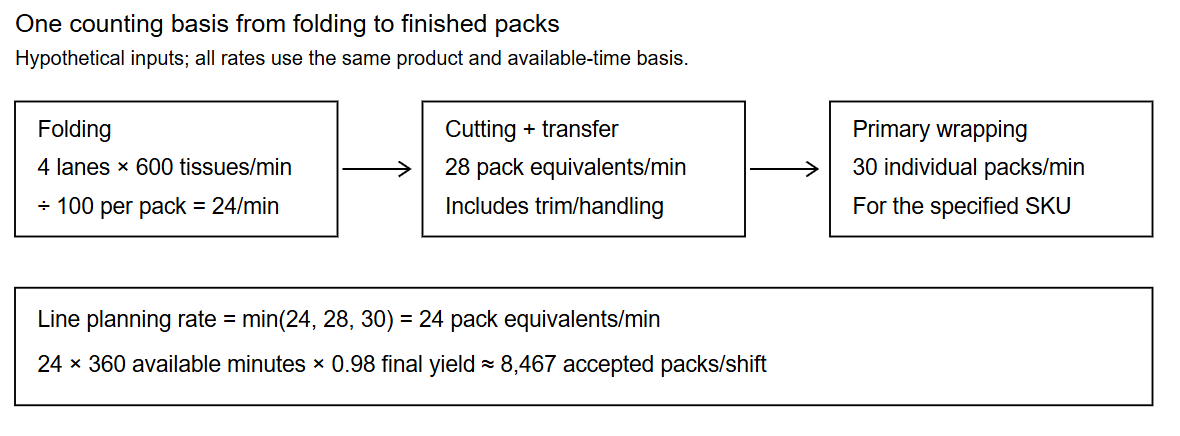
Figure 1. Convert folding output into the same pack unit used by cutting and wrapping before comparing capacity.
Let cutting and packing set the line limit
Put all connected stages on the same basis before calculating finished output:
Planned accepted packs per shift = min(L × s ÷ N, C, P) × T × y
C and P must be sustained capacities for the stated product and available-time basis, not unrelated maximum speeds. Include any additional transfer or downstream stage that may constrain the promised finished product. This is an initial balanced-line estimate; integrated operation must verify the effects of stops and buffers.
For the example, min(24, 28, 30) × 360 × 0.98 = 8,467.2 expected accepted packs, or approximately 8,467 packs per shift. The planning result clears the 8,000-pack target, subject to validation of all assumed inputs.
If the wrapper can sustain only 20 packs/min, the same calculation gives 7,056 accepted packs/shift. Adding a fifth folding lane would not remove that packaging limit. A buffer can absorb short interruptions, but continuously supplying more than the wrapper can process will eventually require the folder to slow or stop.
A cutter's cuts/min rating also needs interpretation. Ask how many saleable stack sections come from each cutting cycle, how many log paths are active, and how end trims and log changes affect sustained output. Use the resulting pack equivalents/min, rather than assuming one cut always equals one pack.
6. Recalculate when the pack count or tissue size changes
More pulls per pack require more folding output for the same pack target. Larger sheets may reduce the available lane count and change stack dimensions. Reconfirm each SKU rather than treating a lane number as a fixed pack-output promise.
| Candidate lanes | Pulls per pack | Folding pack equivalents/min | Line rate with C = 28, P = 30 | Expected accepted packs/shift |
|---|---|---|---|---|
| 3 | 100 | 18 | 18 | About 6,350 |
| 4 | 100 | 24 | 24 | About 8,467 |
| 4 | 150 | 16 | 16 | About 5,645 |
| 6 | 150 | 24 | 24 | About 8,467 |
| 4 | 80 | 30 | 28, limited by cutting/transfer | About 9,878 |
The table deliberately holds the stage capacities constant to isolate the arithmetic. It does not demonstrate that those capacities remain available for different counts. The six-lane candidate also needs a wider layout: at a 200 mm pitch with the same 40 mm allowance, it requires at least 1,240 mm of incoming web in this simplified model. It cannot be fitted into the example's 840 mm web.
Increasing the count from 100 to 150 raises the required folding count by 50% for the same pack output. It may also increase stack height and change cutting, compression, transfer and wrapping performance. Confirm the stack height under the agreed measurement condition, along with tissue size, ply and embossing.
Related topic, planned: facial tissue stack height and packing machine compatibility.
Confirm a configuration using the full product specification

The XY-GU-20A Automatic facial tissue paper making machine product page lists a configurable four-line layout and a speed of 900 sheets/line/min. Confirm whether the quoted sheet counter corresponds to complete tissues, the supported sheet dimensions and the sustained operating conditions before converting that figure into packs. The 600-tissue/min/lane rate used above is a separate hypothetical assumption.
For a connected soft-pack project, the XY-GU-A-B Automatic Soft Packing Facial Tissue Production Line is another configuration to discuss. Its published scope includes folding, log cutting and individual-pack wrapping. Request one capacity calculation for the actual combination rather than assuming that individual machine ratings add up to a guaranteed line output.
| Buyer provides | Supplier confirms |
|---|---|
| Unfolded and folded sheet dimensions, with orientation | Lane pitch, usable width and supported layout |
| Ply count and paper specification | Feeding arrangement and demonstrated count rate |
| Complete tissues or pulls per pack | Counter definition, stack formation and separation |
| Target accepted packs and working schedule | Required lanes, available-time assumptions and yield basis |
| Parent roll width and available supply tolerances | Compatibility at the minimum supplied width |
| Pack sample, stack dimensions and packing format | Cutting, transfer and packing capacities for that SKU |
Ask for a trial using representative tissue and packaging. Record accepted packs over elapsed time, count and dimensions, lane-level defects, stops and rejects. A short stable run supports the operating-rate assumption; a shift forecast also needs the reel changes, cleaning and other events outside that sample. Keep those assumptions with the quotation.
FAQ
Do more folding lanes always mean more finished packs?
Only while folding is the limiting stage and the wider layout is feasible. Once cutting, transfer or wrapping sets the rate, extra lanes do not increase finished output without resolving that constraint.
How should I describe a two-ply 100-pull pack?
Write “100 complete tissues per pack, two plies per tissue.” Ask the supplier to confirm that its sheets/min and counter settings use the same complete-tissue basis.
Can I keep the same lane count with a wider tissue?
Check the actual width layout. A larger cross-web pitch may reduce the number of usable positions unless the parent web and machine working width can also increase. The other unfolded dimension affects the folding or cutting repeat and must be confirmed separately.
Can I double packs per shift by halving the pulls per pack?
Folding pack equivalents double if the tissue rate and other conditions remain unchanged. Finished packs may increase less because the cutter, transfer system or wrapper can become the new limit. Recheck the smaller stack and packing conditions.
What should I send if I do not know the required lane count?
Send unfolded sheet size, ply count, complete tissues or pulls per pack, target accepted packs and parent roll width. Add shift hours, a finished pack sample and the packing format. Ask the supplier to calculate the lanes and identify the stage that limits the proposed output.
Request a proposal for your finished-pack target
Send us your facial tissue specifications and target output to request a configuration proposal and quotation.
Include unfolded sheet dimensions, ply count, sheets or pulls per pack with a clear counting definition, target packs and parent roll width. Request the folding, cutting and packing calculations on the same finished-pack basis.