
 +86-18750595100




Write the fully opened sheet dimensions, the finished folded dimensions and the fold pattern as three separate fields. Add units, dimension directions and a marked sample. A request for a “300 mm napkin machine” does not tell the supplier whether 300 mm describes the open sheet, the folded product or the incoming paper web.
For a paper napkin machine, folded and unfolded size must be checked together with the folding arrangement. A usable specification might read: “Unfolded 300 × 300 mm; folded 150 × 150 mm; 1/4 cross-fold; orientation and opening edge as sample N-A01.” Those dimensions are illustrative; the proposed machine configuration still requires confirmation.
This guide helps a new converting project prepare that specification. For the equipment category, see our napkin paper machine overview.
Separate the sheet, the folded footprint and the package
Unfolded size is the full size of one finished napkin opened flat. Folded size is its outside footprint after folding. Neither figure describes the height of a stack or the outside dimensions of a wrapped pack.
| Field | What to write | What it resolves |
|---|---|---|
| Unfolded size | Full sheet width × length, in mm, with direction labels | Identifies the sheet to be produced |
| Folded size | Outside width × length, in mm, with a fixed viewing orientation | Identifies the finished footprint |
| Fold pattern | Name plus crease drawing, sequence and opening-edge reference | Distinguishes products that share a footprint |
| Ply | Number of tissue layers in one napkin | Separates material construction from folding |
| Pack count | Finished napkins per pack; identify stacks or lanes within it | Defines counting and downstream packing requirements |
| Pack dimensions | Wrapped width × length × height, if already specified | Separates product dimensions from packaging dimensions |
Use one unit throughout the technical drawing. If a sales reference uses centimetres or inches, convert it once and retain the original as a reference. Do not leave an unlabeled “30 × 30” in the quotation.
Use 1/4, 1/6 and 1/8 as fold descriptions, then show the geometry
The examples below use an ideal 300 × 300 mm sheet with equal panels and no offset. They demonstrate how to describe a requirement. They are not universal definitions of every commercial fold with the same name, machine settings or guaranteed production dimensions.
In these drawings, CD is across the incoming web and MD is the web travel direction. Open dimensions are written CD × MD. Folded dimensions are written in the corresponding drawing axes before any rotation for packing.
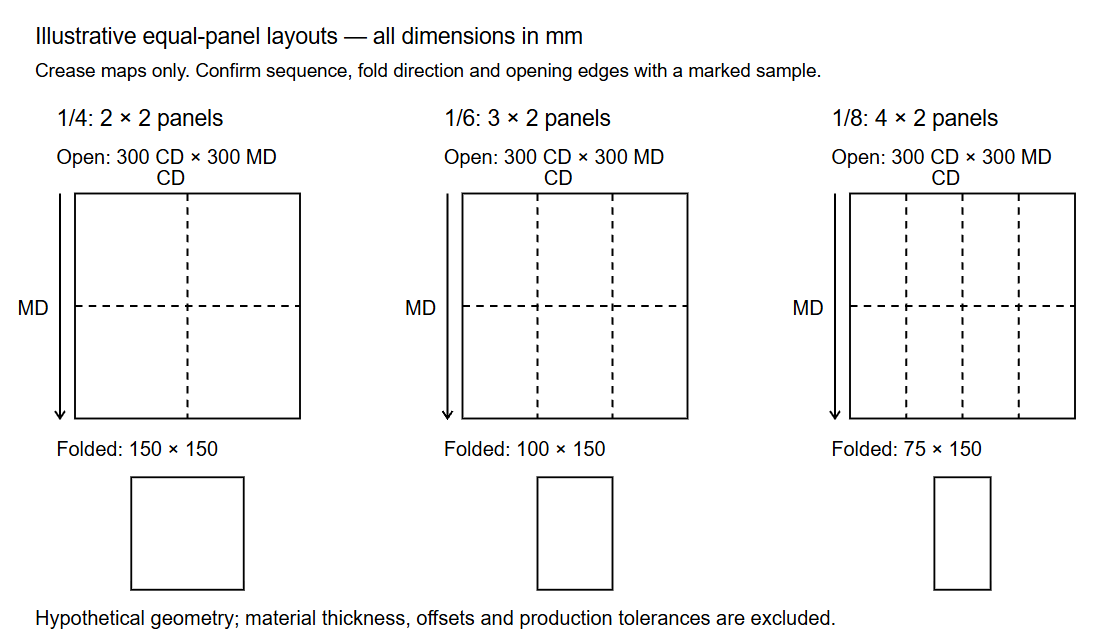
Figure 1. Equal-panel specification examples. Dashed lines mark creases on the opened sheet; the smaller solid rectangles show the resulting footprints. The drawing does not prescribe a machine's folding sequence.
| Example | Open sheet, CD × MD | Illustrative pattern | Folded footprint in drawing axes |
|---|---|---|---|
| 1/4 | 300 × 300 mm | Halve the CD dimension, then halve the MD dimension: cross-fold | 150 × 150 mm |
| 1/6 | 300 × 300 mm | Bring the CD dimension into three equal panels, then halve the MD dimension; C-fold example, to be confirmed by sample | 100 × 150 mm |
| 1/8 | 300 × 300 mm | Halve the CD dimension twice, then halve the MD dimension | 75 × 150 mm |
The ideal area checks are 300 × 300 ÷ 4 = 150 × 150, ÷ 6 = 100 × 150 and ÷ 8 = 75 × 150. These are checks on the illustrated equal-panel geometry. An area ratio does not prove the fold order, opening arrangement or dispenser compatibility.
For an offset, overlapping flap or dispenser pattern, record each panel width and the overlap rather than forcing the product into an equal-panel formula. A trade name such as “1/6” is insufficient to reconstruct the drawing. Two different fold arrangements may have the same outside footprint.
Mark paper direction, the visible face and the opening edge
A square sheet can hide an orientation error because rotating it leaves its outside dimensions unchanged. Mark an MD arrow on the opened sample and identify the cross-web direction. If the machine layout is not yet known, mark the product's A and B edges first and ask the supplier to map them to MD and CD.
Do not infer parent roll width from a folded dimension. The supplier must map the open sheet orientation to the web path, lane arrangement, cutting repeat and any trim. Where upstream slitting is proposed, the slitting width is a separate input.
For a printed or embossed napkin, label the face shown to the user, the top edge of the artwork and the intended opening edge. Include a view of the folded napkin and the same sheet opened flat. A crease map without fold-direction information can leave more than one possible folded result.
Related topic, planned: paper napkin printing machine color configuration.
Turn the product drawing into a folding-section requirement
The product dimensions describe what the line must make. They do not establish which folds or size changes the quoted machine can perform. Ask the supplier to respond to each intended size-and-fold combination, including the required folding parts and changeover procedure.

| Specification item | Requested confirmation |
|---|---|
| Open sheet and folded footprint | Both dimensions achievable together, with agreed tolerances |
| Fold drawing and opening direction | Supported pattern and correspondence with the marked sample |
| Folding section | Required folding plates or formers, rollers and associated cutting or transfer parts, as applicable to the design |
| Second size or second fold | Adjustment versus replacement parts; supplied change parts and setup procedure |
| Ply and paper specification | Suitability for the stated tissue, embossing and folding requirements |
| Counting and stacking | Meaning of one counted piece, stack arrangement and handoff to packing |
The Automatic embossing folding color printing napkin tissue paper making machine is a product to discuss against this specification. Its XY-OQ-7000A page lists 1/2, 1/4, 1/6 and 1/8 folding types. That listing does not establish that one supplied configuration can switch between all folds or make every illustrated dimension. Request confirmation of the selected folding arrangement and included parts.
If parent tissue needs to be slit before feeding the napkin machine, Xinyun's High Speed Jumbo Roll Paper Slitting Rewinding Machine (XY-XX-A) is an upstream product to discuss. Slitting prepares the incoming tissue width; it does not define the napkin's final fold. Confirm that extra step only where the supply and converting widths require it.
Copy this specification block into the quotation request
The completed fields below form an illustrative purchasing brief. The tolerances and operating conditions remain to be agreed; they must be settled before acceptance.
| Product reference | N-A01, revision A; physical sample to carry the same reference |
|---|---|
| Unfolded finished sheet | 300 mm CD × 300 mm MD |
| Folded footprint | 150 × 150 mm in the drawing orientation; measured before wrapping |
| Fold | 1/4 cross-fold; CD in half, then MD in half; face and opening edges to be marked on sample |
| Paper construction | 2-ply; tissue type and GSM per ply to be supplied for review |
| Packing | 100 finished napkins per pack; one napkin means one complete two-ply product |
| Orientation | MD arrow, visible face and opening edge on approved drawing and sample |
| Tolerances | Separate open-size, folded-size and fold-alignment limits; supplier to propose for buyer approval |
| Output requirement | Buyer to enter accepted finished napkins per minute or per shift, with shift duration |
| Attachments | Dimensioned drawing, open/folded photographs and representative finished paper sample |
Keep undecided fields visible. For example, write “GSM per ply: pending sample review” rather than guessing a material specification. If you need several formats, provide one completed block per format and ask the supplier to return a compatibility matrix.
Verify the sample and the written specification together
Measure a finished napkin fully opened without stretching it, then measure its folded footprint in the drawing orientation before wrapping. Agree the measurement conditions, tools, sampling and dimensional limits with the supplier. Check multiple samples from a stable production run using the agreed paper or a documented substitute.
Open a folded sample one stage at a time to verify panel widths, overlap, sequence and opening direction. Check the ply count separately, then confirm that the counted stack contains the specified number of complete napkins. Stack height should be checked under an agreed compression condition if it affects packaging.
Use the same drawing revision on the quotation, sample label and acceptance record. Resolve conflicting numbers or sample details in writing before approving the machine configuration.
FAQ
Can I specify only the unfolded napkin size?
No. The same open sheet can produce different folded footprints and opening arrangements. Provide both sizes, the fold description and a marked sample or drawing so the supplier can confirm the folding configuration.
Does 1/6 fold always mean the open sheet is divided into six equal panels?
Do not assume that from the name alone. The equal-panel example here has a 100 × 150 mm footprint from a 300 × 300 mm sheet. Offset and dispenser arrangements need their own panel dimensions and sample; their trade labels may not describe the same geometry.
Does a 1/8-fold napkin have eight plies?
No. Ply describes the tissue layers in the unfolded product. The illustrated eighth-fold layout has eight geometric panels. A two-ply napkin stays a two-ply product after folding; the stacked thickness is a separate measurement.
Can one machine change between quarter, sixth and eighth fold?
Confirm this for the quoted configuration. Ask which changes are adjustments, which need replacement folding or associated parts, and which formats require another arrangement. A product page listing several fold types does not settle those questions.
What if I have a finished paper sample but no technical drawing?
Send the sample with photos of it folded and fully opened, a ruler in the same plane and an identifying reference. State the ply count and pack quantity, mark the visible face and opening edge, and ask the supplier to return a dimensioned drawing for approval.
Request a proposal using your napkin sample
Send us your napkin specifications and target output to request a configuration proposal and quotation.
Include unfolded and folded dimensions, fold pattern, ply count, pieces per pack and a finished paper sample. Add a drawing or photos showing orientation so the proposed folding configuration can be checked against the product you intend to sell.