
 +86-18750595100





Start with the number of saleable toilet rolls required per shift, then work back through roll length, rolls cut from each log, available production time and quality yield. The result is the average web throughput your rewinder must deliver. A quoted maximum speed alone cannot confirm that output.
For example, a target of 20,000 good rolls per shift, at 30 metres per roll and 20 rolls per log, requires about 85.1 m/min of average web throughput over 360 available minutes at 98% quality yield. That average must include normal log-change cycles. The running speed while paper is actually winding will need to be higher.
This toilet paper machine capacity calculation applies to a converting project using purchased parent tissue rolls. It does not size a paper mill that makes tissue from pulp. For the equipment category, see our टॉयलेट पेपर मशीन सिंहावलोकन।
1. Define the order in good rolls per shift
A good roll meets your agreed specification after cutting and inspection. If the order is for packed goods, use accepted packed rolls as the final counting point. Logs waiting for the saw and rejected rolls do not count toward the order.
Good rolls per shift = order quantity in rolls ÷ production days ÷ shifts per day
An order for 400,000 rolls over 10 production days with two equally productive shifts per day gives 20,000 good rolls per shift. Convert packs or cartons to individual rolls first. Round up the shift target where necessary. If shift hours or product mixes differ, allocate the order to each shift separately.
| निवेश | क्या निर्दिष्ट करना है | यह क्यों मायने रखती है |
|---|---|---|
| तैयार रोल की चौड़ाई | Axial width in mm | Determines how many rolls can be cut from a log |
| रोल की लंबाई | Metres, or sheet count plus perforation pitch | Determines paper length wound per cycle |
| Basis weight and plies | GSM per ply and ply count, or clearly stated combined GSM | Converts roll count to tissue tonnage |
| Parent roll and usable log width | Web width, total trim allowance and confirmed cutting layout | Prevents an overstated rolls-per-log figure |
| अनुसूची | Good rolls per shift, shift hours and shifts per day | Sets the required production rate |
| Product and process details | Diameter, core, embossing, lamination and packing format | Defines the conditions for supplier validation |
2. Convert sheet count to length and rolls to tonnes
Roll length L (m) = sheets per roll × perforation pitch (mm) ÷ 1,000
A roll with 250 sheets at a 120 mm pitch contains 30 m of tissue. The pitch is the distance between successive perforations along the web. Two plies do not turn 250 sheets into 500 sheets: the layers travel together through the finished roll.
Use the finished length requirement and agree how length is measured. A machine counter reading should be checked against the actual finished product, particularly where web tension affects the measured length.
Tissue mass per roll (kg) = roll width (m) × L (m) × combined GSM ÷ 1,000
For equal-weight plies, combined GSM is the GSM per ply multiplied by the number of plies. For unequal plies, add their individual GSM values. Do not multiply by ply count again if the supplied GSM already describes the combined sheet.
A 100 mm-wide, 30 m-long roll made from two 15 GSM plies contains approximately 0.09 kg of tissue. Therefore, 20,000 good rolls represent 1.8 metric tonnes of finished tissue. This calculation excludes cores, adhesive and packaging. Parent tissue consumption will be higher once trim, startup waste and rejects are included; it is a different quantity from saleable tissue output.
3. Calculate how many finished rolls each log provides
A toilet roll rewinder forms a long paper log across the working width. The log is then cut into individual rolls. Each finished roll contains the wound length L; a 30 m winding cycle does not mean that the entire log contains only one finished roll.
Rolls per log n = round down [(web width − total width allowance) ÷ finished roll width]
Use the actual web width running on the machine, rather than the machine's maximum working width. The total allowance must cover the agreed edge and end trim and any cutting allowance required by the actual saw. Confirm the integer cutting layout with the supplier.
For an illustrative 2,060 mm web, a total allowance of 60 mm and 100 mm finished rolls, n = 2,000 ÷ 100 = 20 rolls per log. Do not deduct that same width trim again as a roll-count yield loss: it is already excluded from n.
Related reading: Choosing Parent Roll Width for Toilet Paper: Cut Layout and Trim Loss.
4. Separate available time from winding speed
An eight-hour shift contains 480 minutes, but the rewinder will not spend all 480 minutes winding paper. Build a time budget for breaks without production coverage, cleaning, parent reel changes, threading, adjustments and expected interruptions.
For the calculation below, T is the time available for repeated log cycles after those shift-level losses. Normal core loading, log discharge and other recurring cycle actions remain inside the cycle time.
Average web throughput Vऔसत (m/min) = length wound across repeated cycles ÷ elapsed cycle time
Good rolls per shift Q = Vऔसत × T × n × y ÷ L
Here, y is the accepted-roll quality yield after the width allowance has already been applied. For initial planning, solve for the required throughput:
Required Vऔसत = Q × L ÷ (T × n × y)
If the supplier gives only the speed during winding, ask for complete cycle timing. A simplified cycle model is:
Cycle time c (seconds) = 60 × L ÷ winding speed + additional cycle time
The additional time accounts for the effect of acceleration, deceleration, log discharge, core loading and other cycle actions beyond the ideal constant-speed winding time. Some actions overlap; use measured total elapsed cycle time where possible. Then Q = (60 × T ÷ c) × n × y.
Record every loss once. If measured average throughput already includes reel changes or waiting for the saw, do not subtract those events again from T. Likewise, do not apply another overall efficiency factor to a calculation that already includes the same time and quality losses.
5. Worked example: size capacity for 20,000 good rolls per shift
All figures below are illustrative planning assumptions. They are not a machine test, an industry efficiency benchmark or a guaranteed Xinyun production result.
| मद | अनुमानित मान |
|---|---|
| Target good output Q | 20,000 rolls per shift |
| Finished roll | 100 mm wide; 250 sheets × 120 mm = 30 m |
| ऊतक | 2 plies × 15 GSM = 30 combined GSM |
| Width layout | 2,060 mm web − 60 mm total allowance; 20 rolls per log |
| शिफ्ट की अवधि | 480 मिनट |
| Shift-level losses | 120 minutes in total, excluding recurring log-cycle actions |
| Time available for log cycles T | 360 मिनट |
| Quality yield y | 98% of potential rolls from the trimmed cutting layout |
Check tonnage: 20,000 × 0.09 kg = 1,800 kg of good tissue per shift.
Work back to throughput: 20,000 × 30 ÷ (360 × 20 × 0.98) = 85.03 m/min. Round the requirement up to at least 85.1 m/min of average cycle throughput.
Set a cycle-time limit: 60 × 360 × 20 × 0.98 ÷ 20,000 = 21.168 seconds per log. The average complete cycle must be no longer than about 21.17 seconds under these assumptions.
Test a possible operating point: at 180 m/min, ideal winding time for 30 m is 10 seconds. If additional cycle time is 8 seconds, the complete cycle is 18 seconds.
Check the resulting output: 360 × 60 ÷ 18 = 1,200 logs; 1,200 × 20 × 0.98 = 23,520 good rolls per shift.
That hypothetical 18-second cycle clears the order target. At the same winding speed, 12 seconds of additional cycle time would create a 22-second cycle and produce only about 19,244 good rolls. The cycle timing changes the outcome even though the quoted winding speed stays at 180 m/min.
| परिदृश्य | Required average throughput | Changed assumption |
|---|---|---|
| बेस केस | १० मी/मिनट | 30 m rolls; 20 per log; 360 minutes; 98% yield |
| Longer rolls | १० मी/मिनट | 45 m per roll; other inputs unchanged |
| Fewer rolls per log | १० मी/मिनट | 16 per log; other inputs unchanged |
| Less available time | १० मी/मिनट | 300 available minutes; other inputs unchanged |
These are average requirements, not recommended catalogue speeds. Calculate each SKU separately. For a mixed shift, add the time required for each SKU and the changeovers, then compare the total with the available shift time.
6. Ask the supplier to demonstrate the calculated output
Compare the calculation with a documented trial using your tissue, roll length, width, ply count and finishing requirements, or agreed representative materials. Record elapsed test time, complete log cycles, trim, rejected rolls, accepted rolls and stoppage reasons. Agree tolerances for sheet count or length, width, diameter and winding quality before counting accepted output.
A short uninterrupted run can establish cycle timing, but a shift estimate must also account for reel changes, cleaning and the other events outside that sample. Request the extrapolation assumptions alongside the trial result.
For a complete line, check cutting and packing at the same product specification. In the example, 20,000 accepted rolls over 360 available minutes requires 55.56 good rolls per available minute. The hypothetical rewinder operating point delivers 65.33 good rolls per minute on that basis. Cutting and packing need sufficient capacity and buffering to avoid forcing the rewinder to stop. Convert packs per minute to rolls per minute using the actual pack count, and keep each machine's time and reject assumptions visible.
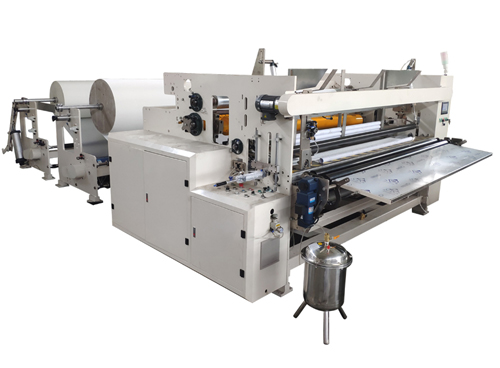
RSI स्वचालित छोटी टॉयलेट रोल पेपर बनाने की मशीन is a configuration to discuss after establishing these requirements. Its published XY-TQ-B specifications list a 1,200–2,800 mm jumbo roll width range and 180–230 m/min speed. Those figures do not establish the good rolls per shift for your SKU; the selected working width, complete cycle timing and downstream capacity still require confirmation.
If you are also considering the Low Price Semi Automatic Small Toilet Roll Paper Machine Production Line, request the same calculation and trial record, including manual transfer and handling time. Use the same accepted-output basis for both proposals.
सामान्य प्रश्न
Can I compare two machines by tonnes per day alone?
Only when their output definitions match. Confirm metric tonnes, hours and shifts per day, finished tissue mass, product specification and loss assumptions. A heavier roll can increase tonnes per day without increasing the number of rolls available for your order.
Can roll diameter replace length or sheet count in the calculation?
No. Diameter also depends on core size, tissue thickness, embossing and winding tightness. Supply length or sheet count with perforation pitch for the throughput calculation, and provide diameter as a separate compatibility requirement.
Does adding a third ply reduce roll output by one third?
There is no fixed reduction. At the same finished length and width, three plies increase tissue mass per roll. Actual roll output depends on whether the proposed configuration can maintain the same cycle timing and quality with that paper combination. Confirm unwind arrangements and operating performance for the three-ply SKU.
Should I add a standard efficiency allowance to the final result?
Use explicit time and quality assumptions first. An extra allowance may duplicate losses already counted. If you need capacity for future orders, state the higher demand as a separate scenario and calculate it using the same method.
What should I send to get a capacity-based quotation?
Send finished roll width, roll length or sheet count with perforation pitch, GSM per ply and ply count, target good rolls per shift, shift hours and shifts per day. Add parent roll dimensions, finished diameter, core details, embossing or lamination requirements and packing format where available. Flag any inputs you have not yet decided so the proposal can state its assumptions.
Request a proposal based on your target output
Send us your toilet roll specifications and target output to request a configuration proposal and quotation.
Include the five starting inputs: roll width, roll length or sheet count, GSM and ply count, target rolls per shift, and shift schedule. Ask for the proposed working width, rolls per log, complete cycle time and expected accepted output to be stated together.